Subterranean termites require continuous access to soil moisture to survive Phoenix heat, forcing colonies deep into the caliche subsoil before they construct shelter tubes up stem walls. Treatment options center on…
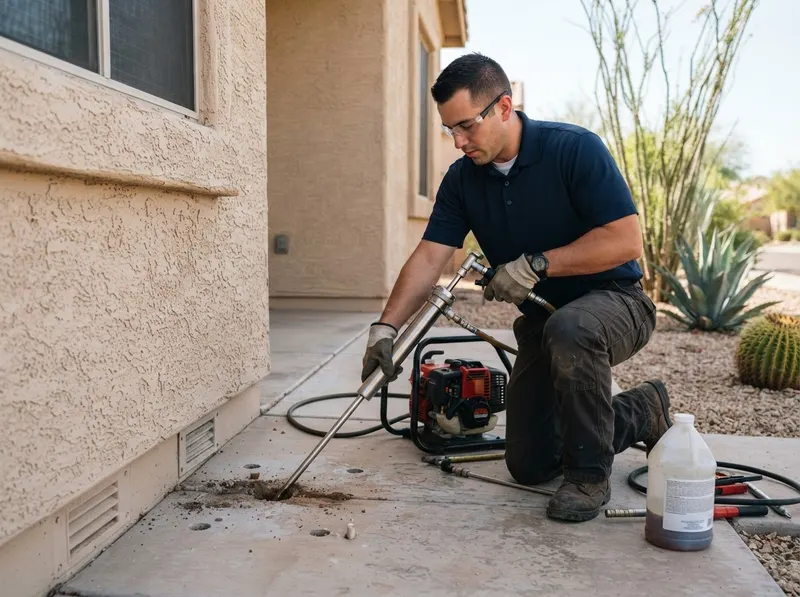
Subterranean termites require continuous access to soil moisture to survive Phoenix heat, forcing colonies deep into the caliche subsoil before they construct shelter tubes up stem walls. Treatment options center on either liquid non-repellent chemical barriers or exterior baiting stations. A liquid application applies a continuous treated zone at a rate of 4 gallons per 10 linear feet per foot of depth around the foundation. In standard stem-wall homes, soil is trenched 6 inches wide and 6 inches deep, while abutting flatwork, such as patios, driveways, and porches, is drilled through concrete at 12-inch intervals to inject termiticide directly into the underlying dirt. In homes with expansive clay or impenetrable rock where drilling through imported flagstone is restricted, perimeter monitoring and bait matrix systems provide colony elimination through insect growth regulators without core drilling, though bait systems require quarterly station monitoring.
Soil composition across Maricopa County dictates treatment mechanics. Dense caliche and clay layers found in North Central Phoenix, Encanto Village, and the Willo Historic District slow fluid dispersion, requiring pressurized rodding tools to saturate subterranean zones without causing chemical runoff. Along the alluvial slopes of Camelback Mountain, Paradise Valley Village, and Desert Ridge, rocky desert soil causes termiticide to leach downward quickly, requiring precise dosage calibration to maintain an intact chemical perimeter. Structures in Arcadia and Maryvale Terrace with legacy slab additions or flood-irrigation histories hold elevated subterranean moisture along footings, which accelerates mud tube building inside expansion joints and behind stucco screeds. Properties bordering native desert terrain, including Ahwatukee Foothills and the Biltmore Area near Piestewa Peak, face elevated termite foraging pressure from desert subterranean colonies nesting under surrounding mesquite root systems.
Subterranean termite treatment differs substantially from drywood termite procedures. Drywood termites nest entirely within structural timbers and do not contact soil, meaning a perimeter ground trench provides zero defense against them. Conversely, subterranean termites do not require whole-structure tent fumigation; they are neutralized from the ground up by severing soil contact. Applying standard surface pest sprays to active subterranean shelter tubes also fails, as worker termites simply seal off the exposed tunnel and relocate entry through hidden expansion gaps or plumbing penetrations. A true structural treatment requires unbroken saturation around every ground-to-wood contact point, ensuring workers carry non-repellent active ingredients back to the subterranean reproductive queen.
Every job gets a firm, written price after a free on-site visit.
Tell us about your subterranean termite treatment job in Phoenix and we'll send a clear, written quote, usually the same day.
 PestWatch Pest Control