Bed bug infestations in Maricopa County escalate rapidly because indoor air conditioning systems provide optimal nesting microclimates while outdoor summer conditions limit external structural cooling. Thermal…
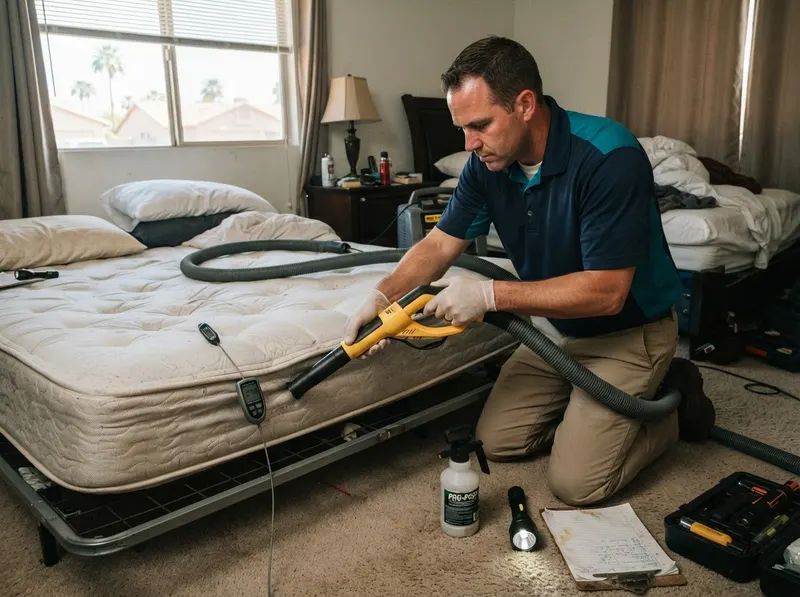
Bed bug infestations in Maricopa County escalate rapidly because indoor air conditioning systems provide optimal nesting microclimates while outdoor summer conditions limit external structural cooling. Thermal remediation operates on clear thermodynamic principles: lethal core exposure occurs when structural air reaches 122°F to 135°F for sustained intervals, denaturing the proteins in adult bed bugs, nymphs, and eggs within mattress seams, box springs, and electrical faceplates. In older housing stock within the Willo Historic District and Encanto Village, plaster walls, lathe, and settled framing create deep channels where pests retreat from basic surface sprays. Deploying high-output electric or indirect-fired heaters paired with directional air movers pushes thermal currents into those inner wall voids, leaving zero cold spots for survival.
Selecting between standalone heat, chemical dusting, or combined thermal and chemical treatment depends entirely on structural density and clutter levels. Thermal heat acts immediately within an 8-hour window, eradicating all life stages without leaving harmful chemical deposits on sleeping surfaces. However, heat alone provides no ongoing protection once structural timbers cool to ambient room temperature. Pairing thermal elevation with localized non-repellent liquid and dust applications behind baseboards in North Central Phoenix brick homes or Desert Ridge multi-story builds creates an active defense perimeter. If a solitary insect survives deep within unheated plumbing insulation, traversing the residual barrier ensures lethal pickup within 48 to 72 hours.
Execution requires precise site staging to protect structural property while achieving uniform thermal lethal thresholds. 1. Technicians survey bedrooms, furniture joints, and utility penetrations using thermal imaging and high-lumen inspection probes. 2. Heavy industrial circulation fans rotate target air masses through the space, systematically monitored with remote temperature sensors logged at 15-minute intervals. 3. Wall outlets and switch covers are pulled to deposit microscopic desiccant silica or non-repellent dust directly into the building envelope. 4. Following cool-down to standard indoor temperatures, technicians complete a final vacuuming with HEPA-rated filtration equipment to remove inert physical debris from carpets and bed frames. Across Paradise Valley Village, Arcadia, and Maryvale Terrace, this integrated application prevents egg re-emergence without requiring families to discard structural mattresses.
Every job gets a firm, written price after a free on-site visit.
Tell us about your bed bug thermal & chemical eradication job in Phoenix and we'll send a clear, written quote, usually the same day.
 PestWatch Pest Control